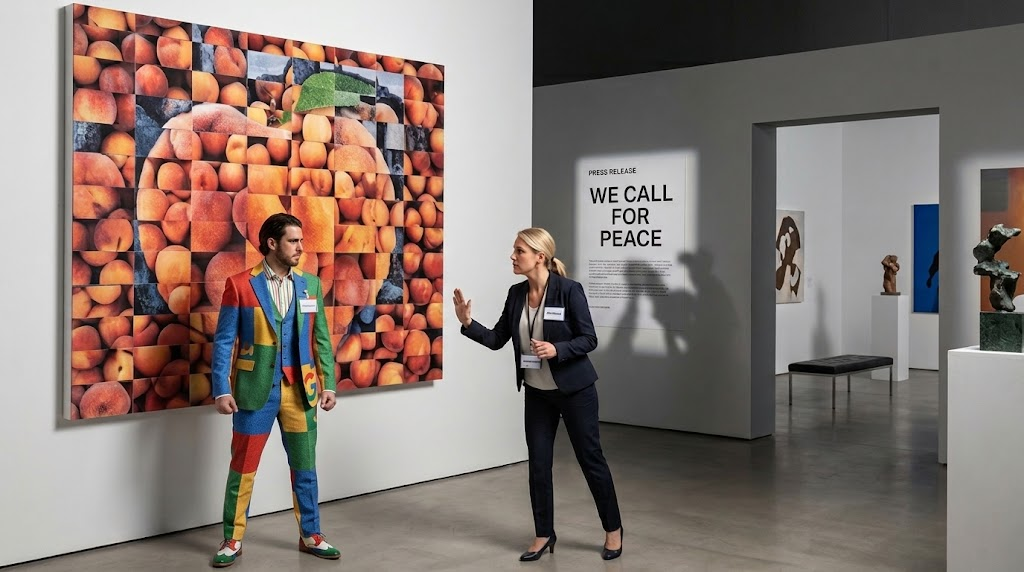

Anyone who has ever found themselves at a private view will know the scene. Somewhere in the air hangs the lavender-scented nectar of prosecco. Someone is staring solemnly at a white square on the wall. And, at precisely the most innocent moment, someone asks: “But shouldn’t art be apolitical?”
The question has a remarkable habit of appearing just as politics stops being an abstraction and starts collecting bodies. Not when a government discusses the cultural budget. Not when a gallery debates whether it meets its latest gender quota. But precisely when bombs are falling, an occupation is under way, or thousands of people are dying in a humanitarian crisis.
Suddenly, the art world — otherwise so fearless when it comes to deconstructing the heteronormativity of wallpaper — develops a profound concern for the pure, unsullied, timeless sanctity of art.
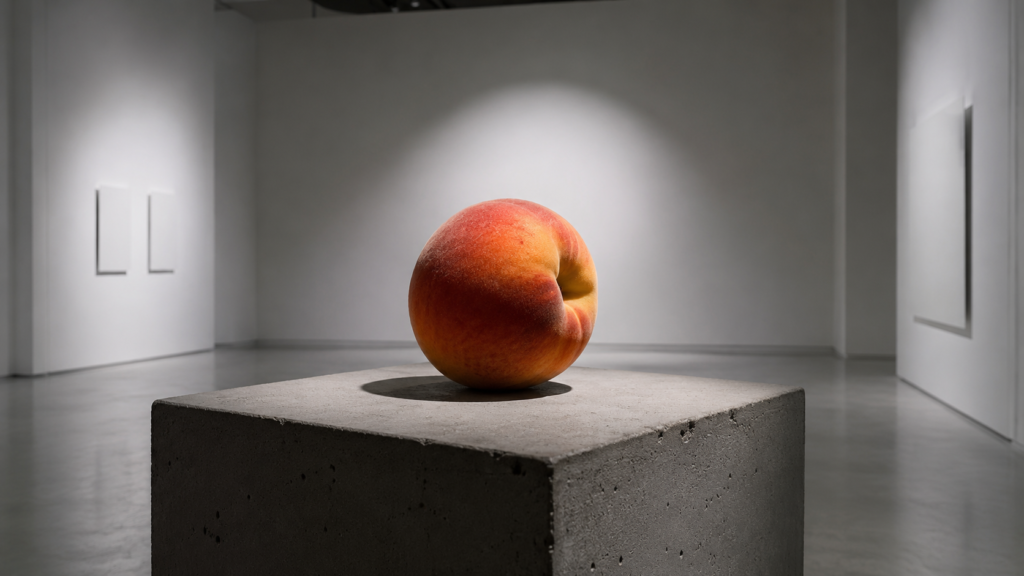
Apolitical art loves peaches
So what, exactly, is this apolitical art supposed to look like?
Ideally, a still life. Preferably peaches.
A peach is round, soft, fragrant and completely uncommitted. It has never issued a statement on Instagram. A peach is so apolitical that its neutrality starts to look suspicious.
An artist can paint one a hundred times. A curator can put it in an exhibition. No one asks which side the peach is on. No one demands a statement from the peach. No one accuses the artist of complicity with the peach.
Perfect.
With a little effort, however, you can politicise absolutely anything. All it takes is for an artist to paint a peach while mentioning that, at the very moment the paint was drying, people somewhere else were dying.
And there it is. It is no longer a still life. It is now an “inappropriate intrusion of reality”.
The biennale: dialogue behind closed doors
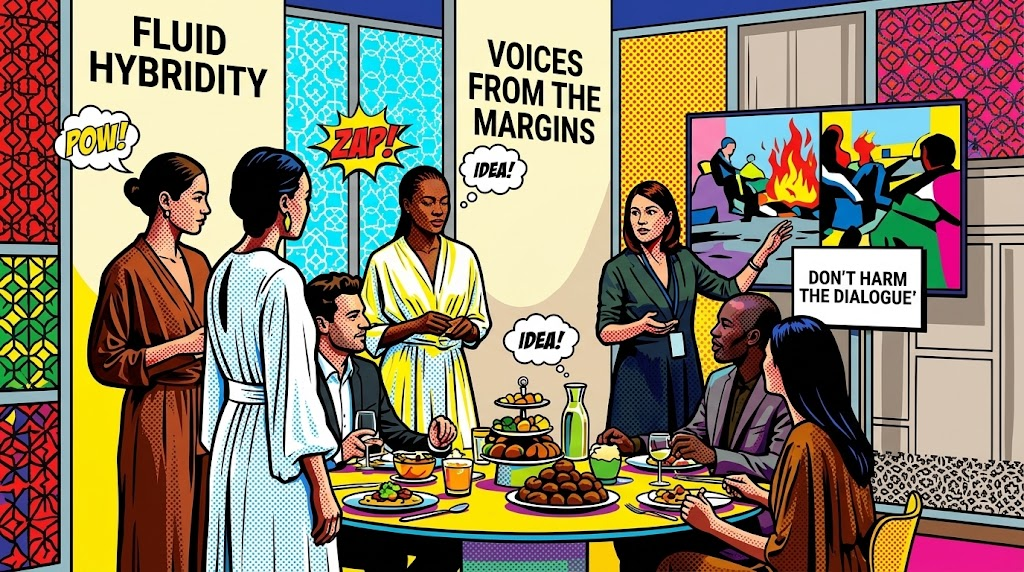
No species has a stronger appetite for “intercultural dialogue” than the curator of an international biennale.
Every biennale press release mentions it at least five times. It wants to build bridges. It wants to create spaces for encounter. It wants to foster connections between nations. It wants us to listen to voices from the margins.
In short, it wants the whole world to embrace over a Swedish buffet of vegan meatballs.
There is, however, one small condition attached to this beautiful, inclusive, silky dialogue: it must not concern the reason why the person whose voice we have invited from the margins happens to live there.
We must not discuss occupations. We must not discuss blockades. We must not discuss who happens to be funding this particular “international space”.
Because the moment an artist at a biennale talks about war instead of “fluid hybridity”, the welcoming curator undergoes a remarkable transformation into a very concerned curator.
And a concerned curator always asks the same question:
“But won’t this harm the dialogue?”
Sponsors: love without conditions
Nowhere is compassion for suffering more efficient than in a gallery press release issued after the outbreak of war.
“We are deeply concerned.”
“We stand in solidarity.”
“We call for peace.”
All beautifully laid out in fifteen neat lines, with carefully considered paragraphs and enough empty space for an Instagram carousel.
Things become rather less tidy when you ask what, exactly, pays for all this deep concern accompanied by a sponsor’s logo.
A gallery that posts an emotional statement about a humanitarian crisis on Thursday may, come Monday, be accepting money with gratitude from a foundation whose investment portfolio is more eclectic than its contemporary art programme.
And when an artist asks about it, they are suddenly “ideologically divisive”.
Not someone asking an ethical question.
Someone who is disrupting the buffet.
Boycotts, censorship and the endless ping-pong match
The moment someone proposes a cultural boycott, a game begins in which the winner is invariably the person who can sound most outraged while claiming neutrality.
“Don’t mix art with politics!” cries someone whose entirely apolitical work has spent years travelling between institutions funded by the entirely apolitical budgets of entirely apolitical states.
“Boycotts are censorship!” cries another, who would be an enthusiastic defender of free expression — provided that expression took place somewhere else, at another time, and preferably in a manner that did not inconvenience any sponsors.
And the artist?
These days, there are essentially three strategies available.
Stay silent — and be accused of complicity.
Speak out — and be accused of opportunism.
Or make an installation out of peaches — and be accused of making something too political, because, in the context of all this, even a peach can no longer be considered innocent.
So, should culture be apolitical?
The most ingenious thing about the demand for apolitical culture is that the demand itself is perfectly political.
Silence is not neutral.
Refusing to take a position is not objective.
When a gallery decides “not to take a position”, it has already taken one.
And that position is essentially this:
“At this particular moment, we would rather not disturb our sponsors than disturb the bombs.”
Does anyone genuinely want apolitical art?
Very well. We can provide it.
Let painters paint landscapes. Let biennales organise exhibitions about water, air, light and silence.
Especially silence.
The purest, most refined, institutionally protected silence that money from a controversial sponsor can buy.
And then, finally, we will have the thing everyone claims to want: a culture that remains so exquisitely, so elegantly and so consistently silent in the face of war that it ends up screaming all by itself.