

The Boy Named “Mr. Why”
Long before he flipped the mathematics world upside down, Kurt Gödel was just a kid growing up in Brno (in what is today the Czech Republic) with an insatiable appetite for answers. Born in 1906, his relentless curiosity earned him the nickname Herr Warum—or “Mr. Why”—from his family.
That endless questioning eventually led him to the University of Vienna. Though he initially set out to study physics, he quickly fell in love with mathematics. It turned out to be a match made in history.
Breaking Math (Literally) at Age 25
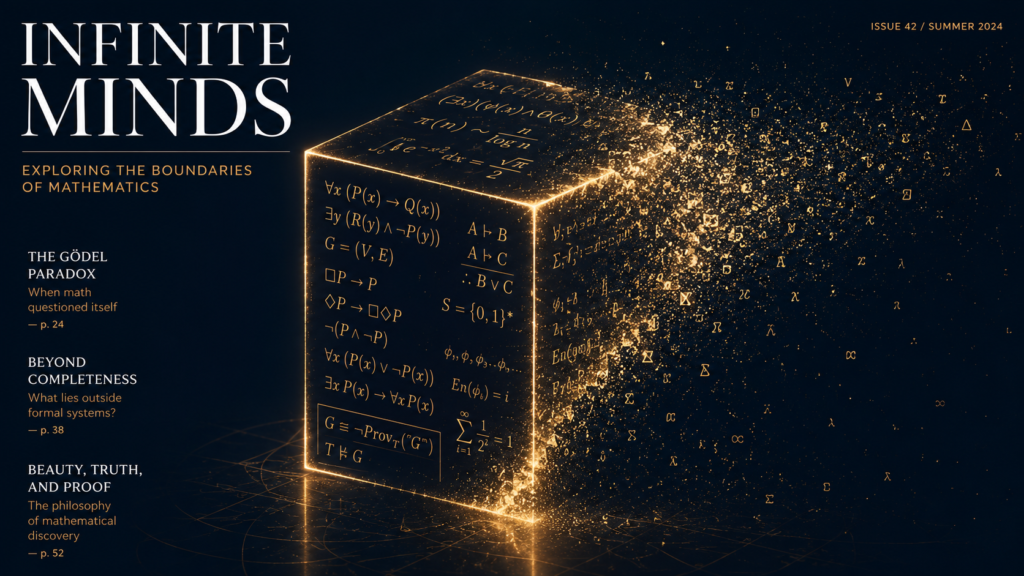
In 1931, at just twenty-five years old, Gödel published his famous Incompleteness Theorems. To put it simply, he shattered the core belief that all mathematical truths could be proven within a given system.
Here is what his ground-breaking logic boiled down to:
- No absolute completeness: In any sufficiently complex logical framework, there will always be true statements that cannot be proven using the rules of that system.
- Math is infinite: Mathematics can never be neatly wrapped up into a single, perfect box—there will always be unprovable truths left to discover.
It was a brilliant realization, but as political unrest spread across Europe in the 1930s, Vienna ceased to be a safe haven for free thinkers. Gödel packed his bags and moved to the United States.
A New Home, Einstein, and a Glitch in the U.S. Constitution
Gödel settled at the prestigious Institute for Advanced Study in Princeton, New Jersey. There, he forged a close friendship with none other than Albert Einstein. The two were often seen taking long walks around campus. In fact, Einstein once admitted that he mostly went to his office just to have the chance to walk home with Gödel.
Yet, alongside Gödel’s genius was a mind increasingly weighed down by paranoia and obsession.
The Constitution Loophole
When Gödel prepared for his U.S. citizenship exam in 1947, he analyzed the U.S. Constitution with his trademark mathematical precision. Naturally, he discovered a subtle logical flaw—a loophole that he believed could theoretically allow someone to turn the United States into a dictatorship completely legally.
On the day of his citizenship interview, his friends Einstein and economist Oskar Morgenstern had to actively steer him away from explaining this loop-hole to the judge so he wouldn’t accidentally tank his own application. Luckily, he passed!

When Pure Logic Becomes Paranoia
Gödel’s mind was a paradox: the very logic that allowed him to revolutionize mathematics also created a mental prison. As time went on, his anxieties evolved into deep paranoia.
- Fear of Poison: He became convinced that people were trying to poison him or that gas was leaking from his stove. As a result, he refused to eat anything unless his wife tasted it first.
- Fear of Fresh Air: Believing drafty rooms and outdoor air caused severe illness, he sealed his windows shut and wore a heavy winter coat even in the middle of summer.
To an outsider, this looks like pure irrationality. But through Gödel’s internal lens, it was completely systematic: if the world is dangerous and error-prone, strict protective measures must be enforced. He was simply applying hyper-rigorous logic to everyday survival.
The tragic twist of Gödel’s life came in late 1977, when his wife was hospitalized and could no longer prepare or taste his food. Unable to trust anyone else, Gödel refused to eat entirely. He passed away in January 1978, serving as a heartbreaking reminder of how fragile the line between extreme genius and profound affliction can be.