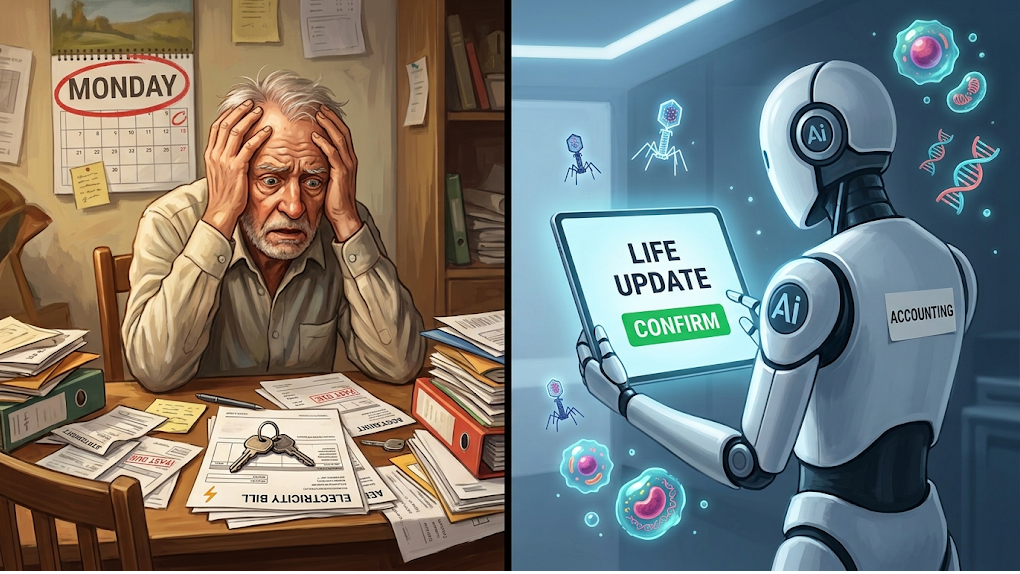

Until recently, human beings had a fairly straightforward life plan. Get born, go to school, get a job, grow old, retire, and eventually start complaining about young people, the price of groceries and the quality of the NHS.
Now it appears we may have misunderstood the assignment.
Two extraordinary pieces of scientific news have surfaced. In one corner, researchers are exploring whether human cells can be persuaded to forget how old they are. In the other, artificial intelligence has helped design viruses capable of attacking bacteria that have stopped responding to antibiotics.
We have, in other words, reached the stage of civilisation where the most important question is no longer whether technology can change life.
It is whether we are still keeping up with it.
First, let’s have a word with Father Time
One of the most intriguing figures in this story is the American geneticist David Sinclair, who has spent years investigating whether ageing is something we simply have to accept – or something biology might eventually allow us to reverse.
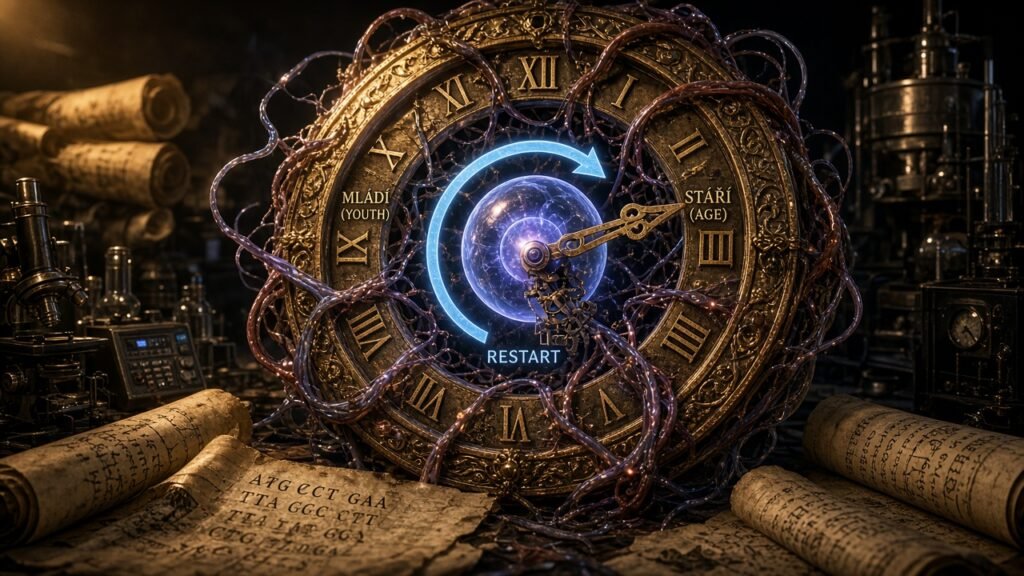
His work is based, among other things, on the idea that cells gradually lose their ability to read and maintain the instructions contained in their DNA correctly. If part of ageing is essentially a problem with the biological software, perhaps the software can be reset.
Researchers have produced striking results in animals, and Sinclair has openly discussed the possibility that techniques based on cellular reprogramming could one day rejuvenate human tissues.
In recent interviews, he has gone further, discussing the possibility of resetting the biological age of the entire body.
That is, naturally, wonderful news.
Particularly if you are 57, have two dodgy knees and have just discovered that your electricity bill now represents a new branch of theoretical physics.
“Doctor, could you make me young again?”
“Certainly.”
“How young?”
“Twenty.”
“Splendid. And could we skip university this time?”
Of course, we are not there yet.
There is a rather important gap between promising experiments in cells and animals and a safe treatment that can reliably turn any human being into a healthy 20-year-old. Science has a habit of placing such gaps precisely where journalists would prefer them not to be.
Still, the idea itself is extraordinary.
For thousands of years, humanity searched for the fountain of youth. We looked in mythical springs, magical potions, exotic diets and, more recently, in bottles of very expensive supplements with photographs of suspiciously healthy-looking blueberries on the label.
Now scientists are looking inside the cells.
And the cells, rather inconveniently, appear to have settings.
Then along came AI
If that were not enough, another extraordinary development arrived.
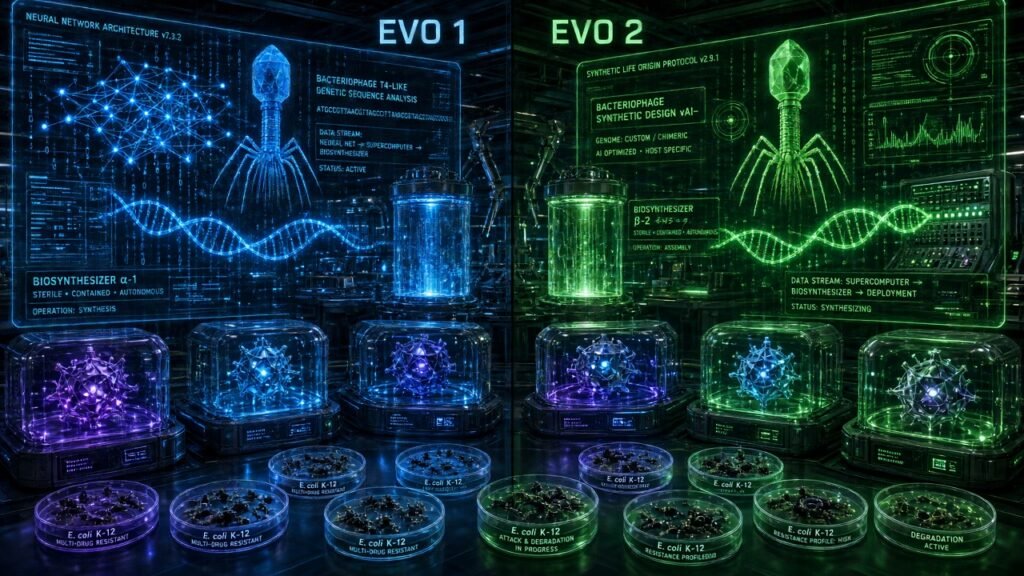
Scientists have used artificial intelligence to design new bacteriophages – viruses that infect bacteria. AI models called Evo 1 and Evo 2 generated new genetic sequences, some of which researchers synthesised and tested. Several of the resulting phages were able to infect and kill strains of E. coli, including antibiotic-resistant ones.
Let us pause here.
Because even five years ago, this sentence would have sounded like the plot of a particularly ambitious science-fiction film.
Today it sounds like something that happened in a laboratory.
AI designed the genetic instructions.
Scientists made some of them.
The resulting viruses worked against bacteria.
No, ChatGPT has not secretly assembled a squadron of killer viruses and released them into the neighbourhood because somebody asked it to “make healthcare more efficient”.
But the direction of travel is remarkable.
Bacteria have been fighting back against antibiotics for decades. Humanity responded by developing more antibiotics, using them extensively and occasionally behaving as though evolution had signed a non-aggression pact.
It had not.
Some bacteria evolved resistance.
So we found ourselves in a rather awkward conversation.
“This bacterium doesn’t respond to this antibiotic.”
“Try another one.”
“It doesn’t respond to that either.”
“Something stronger?”
“No.”
“Something really, really strong?”
“No.”
“Right. Call the AI.”
And somewhere inside a laboratory, the AI presumably replied:
“Give me a moment.”
Evolution gets a computer
Perhaps the most fascinating aspect of all this is that artificial intelligence is beginning to change the speed at which we can explore biology.
Evolution works through variation and selection. Humans do much the same thing, except we have laboratories, computers, grant applications and an extraordinary ability to spend three years debating the name of a project.
AI can search through vast numbers of possible biological sequences and identify patterns that would be extremely difficult for a human researcher to explore manually.
That could prove enormously useful in the fight against antimicrobial resistance.
It is also rather unsettling.
Because we have now entered an era in which artificial intelligence can help design biological systems.
Which means that the central question is slowly changing.
It is no longer simply:
“What can AI do?”
It is:
“What should we allow it to do?”
That distinction matters enormously.
The potential benefits are huge. So are the questions surrounding safety, regulation and misuse. The current research is nowhere near a world in which AI independently designs universal cures or commands an army of programmable viruses.
But the fact that researchers can already ask an AI system to explore biological possibilities that humans would struggle to navigate manually is remarkable enough.
And now put the two stories together
So here we are.
On one side, researchers are exploring ways of persuading human cells to behave as though they were younger.
On the other, AI is helping scientists design viruses that can attack bacteria which have learned to ignore antibiotics.
In other words, we may eventually be able to make the human younger while sending an AI-designed virus to kill the bacterium.
The human gets a fresh life.
The bacterium gets a rather less fresh one.
And artificial intelligence stands somewhere in the middle, presumably waiting for us to ask whether we would like to install the latest update.
Perhaps this is what makes the current moment so peculiar.
For centuries, humanity tried to outsmart nature.
Now we are beginning to understand it well enough to modify its instructions.
And yet we remain the same people.
We still lose our keys while holding them.
We still buy gym memberships in January and use them approximately three times.
We still know that we should eat less, sleep more and exercise regularly.
And we still secretly hope that one day a scientist will simply inject something into our arm and say:
“Done. You’re 20 again.”
“Brilliant. Can I have my knees back?”
“Of course.”
“And my hair?”
“We’re working on it.”
“And my student loan?”
“Absolutely not.”
Maybe, one day, ageing really will become a technical problem rather than an unavoidable biological fate.
Maybe resistant bacteria will routinely meet their match in viruses designed with the assistance of artificial intelligence.
Both possibilities are astonishing.
But perhaps we should keep a little healthy scepticism in reserve.
Because between “it works in a mouse” and “we can safely rejuvenate every human being” lies one rather important detail.
The human being.
And humans, as we know, are not mice.
For one thing, mice have never opened social media, read the comments beneath a newspaper article and concluded that modern science is a global conspiracy.
So yes, we may be approaching a world in which we can reset cells and programme viruses.
I would not cancel the pension contributions just yet.
And perhaps keep a respectable distance from anyone offering you a home-made fountain of youth in a garage.
Because if science has taught us anything, it is that nature always gets a vote.
So do bacteria.
So do viruses.
Perhaps even artificial intelligence.
But there is one institution that has survived every technological revolution so far.
The accounts department.
And, frankly, that may be the real reason humanity will never become immortal.